between points A and B, VB−VA is defined to be the change in potential energy of a charge q moved from A to B, divided by the charge. Units of
potential difference
are joules per
coulomb
, given the name volt (V) after Alessandro Volta.
1V=1J/C
The familiar term
voltage
is the common name for
electric potential difference
. Keep in mind that whenever a
voltage
is quoted, it is understood to be the
potential difference
between two points. For example, every battery has two terminals, and its
voltage
is the
potential difference
between them. More fundamentally, the point you choose to be zero volts is arbitrary. This is analogous to the fact that gravitational potential energy has an arbitrary zero, such as sea level or perhaps a lecture hall floor. It is worthwhile to emphasize the distinction between
potential difference
and electrical potential energy.
Potential Difference
and Electrical Potential Energy
The relationship between
potential difference
(or
voltage
) and electrical potential energy is given by
ΔV=ΔUq(7.3.3)
or
ΔU=qΔV.(7.3.4)
Voltage
is not the same as energy.
Voltage
is the energy per unit charge. Thus, a motorcycle battery and a car battery can both have the same
voltage
(more precisely, the same
potential difference
between battery terminals), yet one stores much more energy than the other because ΔU=qΔV. The car battery can move more charge than the motorcycle battery, although both are 12-V batteries.
Example 7.3.1: Calculating Energy
You have a 12.0-V motorcycle battery that can move 5000 C of charge, and a 12.0-V car battery that can move 60,000 C of charge. How much energy does each deliver? (Assume that the numerical value of each charge is accurate to three significant figures.)
Strategy
To say we have a 12.0-V battery means that its terminals have a 12.0-V
potential difference
. When such a battery moves charge, it puts the charge through a
potential difference
of 12.0 V, and the charge is given a change in potential energy equal to ΔU=qΔV. To find the energy output, we multiply the charge moved by the
potential difference
.
Solution
For the motorcycle battery, q=5000C and ΔV=12.0V. The total energy delivered by the motorcycle battery is
and energy are related, but they are not the same thing. The voltages of the batteries are identical, but the energy supplied by each is quite different. A car battery has a much larger engine to start than a motorcycle. Note also that as a battery is discharged, some of its energy is used internally and its
terminal voltage
drops, such as when headlights dim because of a depleted car battery. The energy supplied by the battery is still calculated as in this example, but not all of the energy is available for external use.
Exercise 7.3.1
How much energy does a 1.5-V AAA battery have that can move 100 C?
Answer
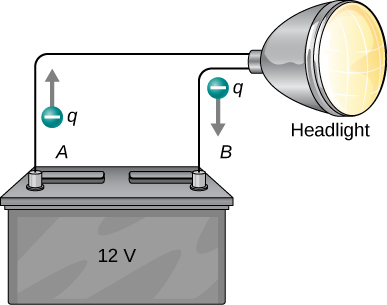
Note that the energies calculated in the previous example are absolute values. The change in potential energy for the battery is negative, since it loses energy. These batteries, like many electrical systems, actually move negative charge—electrons in particular. The batteries repel electrons from their negative terminals (A) through whatever circuitry is involved and attract them to their positive terminals (B), as shown in Figure 7.3.1. The change in potential is ΔV=VB−VA=+12V and the charge q is negative, so that ΔU=qΔV is negative, meaning the potential energy of the battery has decreased when q has moved from A to B.
Figure 7.3.1: A battery moves negative charge from its negative terminal through a headlight to its positive terminal. Appropriate combinations of chemicals in the battery separate charges so that the negative terminal has an excess of negative charge, which is repelled by it and attracted to the excess positive charge on the other terminal. In terms of potential, the positive terminal is at a higher voltage than the negative terminal. Inside the battery, both positive and negative charges move.
Example 7.3.2: How Many Electrons Move through a Headlight Each Second?
When a 12.0-V car battery powers a single 30.0-W headlight, how many electrons pass through it each second?
Strategy
To find the number of electrons, we must first find the charge that moves in 1.00 s. The charge moved is related to
voltage
and energy through the equations ΔU=qΔV. A 30.0-W lamp uses 30.0 joules per second. Since the battery loses energy, we have ΔU=−30J and, since the electrons are going from the negative terminal to the positive, we see that ΔV=+12.0V.
Solution
To find the charge q moved, we solve the equation ΔU=qΔV:
q=ΔUΔV.(7.3.5)
Entering the values for ΔU and ΔV, we get
q=−30.0J+12.0V=−30.0J+12.0J/C=−2.50C.
The number of electrons ne is the total charge divided by the charge per
electron
. That is,
ne=−2.50C−1.60×10⁻¹⁹C/e−=1.56×1019electrons.
Significance
This is a very large number. It is no wonder that we do not ordinarily observe individual electrons with so many being present in ordinary systems. In fact, electricity had been in use for many decades before it was determined that the moving charges in many circumstances were negative. Positive charge moving in the opposite direction of negative charge often produces identical effects; this makes it difficult to determine which is moving or whether both are moving.
Exercise 7.3.2
How many electrons would go through a 24.0-W lamp?
Answer
The
Electron-Volt
The energy per
electron
is very small in macroscopic situations like that in the previous example—a tiny fraction of a joule. But on a submicroscopic scale, such energy per particle (
electron
,
proton
, or
ion
) can be of great importance. For example, even a tiny fraction of a joule can be great enough for these particles to destroy organic molecules and harm living tissue. The particle may do its damage by direct collision, or it may create harmful X-rays, which can also inflict damage. It is useful to have an energy unit related to submicroscopic effects.
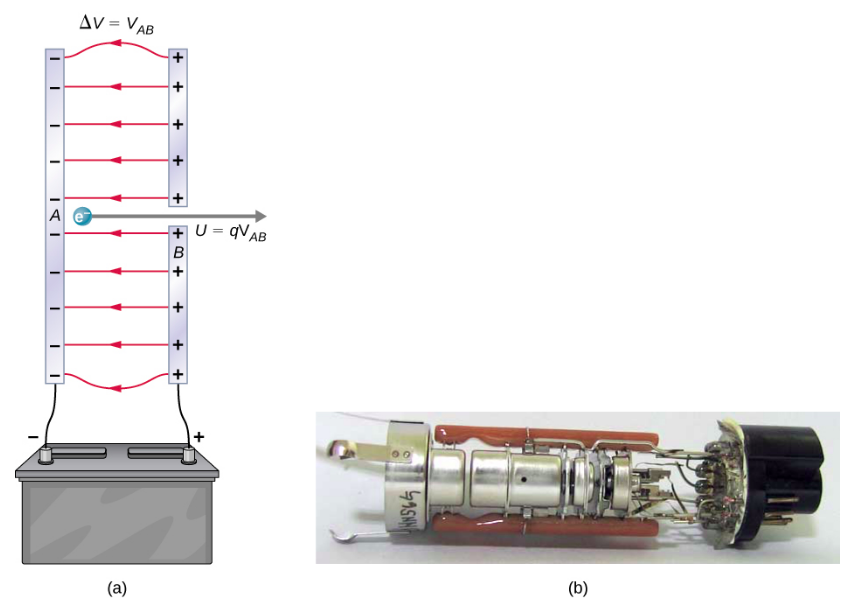
Figure 7.3.2 shows a situation related to the definition of such an energy unit. An
electron
is accelerated between two charged metal plates, as it might be in an old-model television tube or oscilloscope. The
electron
gains kinetic energy that is later converted into another form—light in the television tube, for example. (Note that in terms of energy, “downhill” for the
electron
is “uphill” for a positive charge.) Since energy is related to
voltage
by ΔU=qΔV, we can think of the joule as a
coulomb
-volt.Figure 7.3.2: A typical
electron
gun accelerates electrons using a
potential difference
between two separated metal plates. By conservation of energy, the kinetic energy has to equal the change in potential energy, so KE=qV. The energy of the
electron
in
electron
-volts is numerically the same as the
voltage
between the plates. For example, a 5000-V
potential difference
produces 5000-eV electrons. The conceptual construct, namely two parallel plates with a hole in one, is shown in (a), while a real
electron
gun is shown in (b).
The
Electron-Volt
Unit
On the submicroscopic scale, it is more convenient to define an energy unit called the
electron-volt
(eV), which is the energy given to a fundamental charge accelerated through a
of 1 V is given an energy of 1 eV. It follows that an
electron
accelerated through 50 V gains 50 eV. A
potential difference
of 100,000 V (100 kV) gives an
electron
an energy of 100,000 eV (100 keV), and so on. Similarly, an
ion
with a double positive charge accelerated through 100 V gains 200 eV of energy. These simple relationships between accelerating
voltage
and particle charges make the
electron-volt
a simple and convenient energy unit in such circumstances.
The
electron-volt
is commonly employed in submicroscopic processes—chemical valence energies and molecular and nuclear binding energies are among the quantities often expressed in
electron
-volts. For example, about 5 eV of energy is required to break up certain organic molecules. If a
proton
is accelerated from rest through a
potential difference
of 30 kV, it acquires an energy of 30 keV (30,000 eV) and can break up as many as 6000 of these molecules (30,000eV:5eVpermolecule=6000molecules). Nuclear decay energies are on the order of 1 MeV (1,000,000 eV) per event and can thus produce significant biological damage.
Conservation of Energy
The total energy of a system is conserved if there is no net addition (or subtraction) due to work or
heat transfer
. For conservative forces, such as the
electrostatic force
, conservation of energy states that mechanical energy is a constant.
Mechanical energy is the sum of the kinetic energy and potential energy of a system; that is, K+U=constant. A loss of U for a charged particle becomes an increase in its K. Conservation of energy is stated in equation form as
K+U=constant(7.3.9)
or
Ki+Ui=Kf+Uf(7.3.10)
where i and f stand for initial and final conditions. As we have found many times before, considering energy can give us insights and facilitate problem solving.
Example 7.3.3: Electrical Potential Energy Converted into Kinetic Energy
Calculate the final speed of a free
electron
accelerated from rest through a
potential difference
of 100 V. (Assume that this numerical value is accurate to three significant figures.)
Strategy
We have a system with only conservative forces. Assuming the
electron
is accelerated in a vacuum, and neglecting the gravitational force (we will check on this assumption later), all of the electrical potential energy is converted into kinetic energy. We can identify the initial and final forms of energy to be
are negative, as in Figure 7.3.2. From the discussion of
electric charge
and
electric field
, we know that electrostatic forces on small particles are generally very large compared with the gravitational force. The large final speed confirms that the gravitational force is indeed negligible here. The large speed also indicates how easy it is to accelerate electrons with small voltages because of their very small mass. Voltages much higher than the 100 V in this problem are typically used in
electron
guns. These higher voltages produce
electron
speeds so great that effects from special relativity must be taken into account and will be discussed elsewhere. That is why we consider a low
voltage
(accurately) in this example.
Exercise 7.3.3
How would this example change with a positron? A positron is identical to an
electron
except the charge is positive.
Answer
Voltage
and
Electric Field
So far, we have explored the relationship between
voltage
and energy. Now we want to explore the relationship between
voltage
and
electric field
. We will start with the general case for a non-uniform E⃗ field. Recall that our general formula for the potential energy of a test charge q at point P relative to reference point R is
Up=−∫pRF⃗ ⋅dl⃗ .(7.3.15)
When we substitute in the definition of
electric field
(E⃗ =F⃗ /q), this becomes
Up=−q∫pRE⃗ ⋅dl⃗ .(7.3.16)
Applying our definition of potential (V=U/q) to this potential energy, we find that, in general,
Vp=−∫pRE⃗ ⋅dl⃗ .(7.3.17)
From our previous discussion of the potential energy of a charge in an
electric field
, the result is independent of the path chosen, and hence we can pick the integral path that is most convenient.
Consider the special case of a positive point charge q at the origin. To calculate the potential caused by q at a distance r from the origin relative to a reference of 0 at infinity (recall that we did the same for potential energy), let P=r and R=∞, with dl⃗ =dr⃗ =r^dr and use E⃗ =kqr2r^. When we evaluate the integral
Vp=−∫pRE⃗ ⋅dl⃗ (7.3.18)
for this system, we have
Vr=−∫r∞kqr2dr=kqr−kq∞=kqr.(7.3.19)
This result,
Vr=kqr(7.3.20)
is the standard form of the potential of a point charge. This will be explored further in the next section.
To examine another interesting special case, suppose a uniform
electric field
E⃗ is produced by placing a
potential difference
(or
voltage
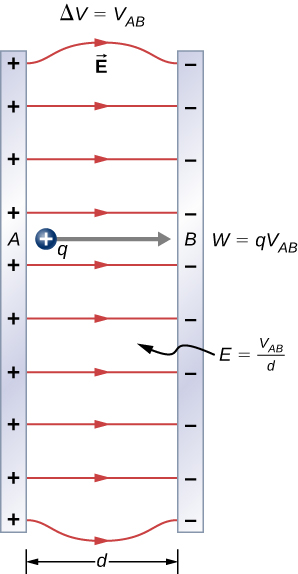
) ΔV across two parallel metal plates, labeled A and B (Figure 7.3.3). Examining this situation will tell us what
voltage
is needed to produce a certain
electric field
strength. It will also reveal a more fundamental relationship between
electric potential
and
electric field
.Figure 7.3.3: The relationship between V and E for parallel conducting plates is E=V/d. (Note that ΔV=VAB in magnitude. For a charge that is moved from plate A at higher potential to plate B at lower potential, a minus sign needs to be included as follows: −ΔV=VA−VB=VAB.)
From a physicist’s point of view, either ΔV or E⃗ can be used to describe any interaction between charges. However, ΔV is a scalar quantity and has no direction, whereas E⃗ is a vector quantity, having both magnitude and direction. (Note that the magnitude of the
electric field
, a scalar quantity, is represented by E.) The relationship between ΔV and E⃗ is revealed by calculating the work done by the
electric force
in moving a charge from point A to point B. But, as noted earlier, arbitrary charge distributions require calculus. We therefore look at a uniform
electric field
as an interesting special case.
The work done by the
electric field
in Figure 7.3.3 to move a positive charge q from A, the positive plate, higher potential, to B, the negative plate, lower potential, is
W=−ΔU=−qΔV.(7.3.21)
The
potential difference
between points A and B is
−ΔV=−(VB−VA)=VA−VB=VAB.(7.3.22)
Entering this into the expression for work yields
W=qVAB.(7.3.23)
Work is W=F⃗ ⋅d⃗ =Fdcosθ: here cosθ=1, since the path is parallel to the field. Thus, W=Fd. Since F=qE we see that W=qEd.
Substituting this expression for work into the previous equation gives
qEd=qVAB.(7.3.24)
The charge cancels, so we obtain for the
voltage
between points A and B.
In uniform E-field only:
VAB=Ed(7.3.25)
E=VABd(7.3.26)
where d is the distance from A to B, or the distance between the plates in Figure 7.3.3. Note that this equation implies that the units for
electric field
are volts per meter. We already know the units for
electric field
are newtons per
coulomb
; thus, the following relation among units is valid:
1N/C=1V/m.
Furthermore, we may extend this to the integral form. Substituting Equation 7.3.3 into our definition for the
potential difference
between points A and B, we obtain
VAB=VB−VA=−∫BRE⃗ ⋅dl⃗ +∫ARE⃗ ⋅dl⃗ (7.3.28)
which simplifies to
VB−VA=−∫BAE⃗ ⋅dl⃗ .(7.3.29)
As a demonstration, from this we may calculate the
potential difference
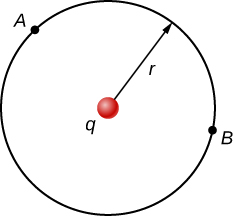
between two points (A and B) equidistant from a point charge q at the origin, as shown in Figure 7.3.4.Figure 7.3.4: The arc for calculating the
potential difference
between two points that are equidistant from a point charge at the origin.
To do this, we integrate around an arc of the circle of constant radius r between A and B, which means we let dl⃗ =rφ^dφ, while using E⃗ =kqr2r^. Thus,
ΔV=VB−VA=−∫BAE⃗ ⋅dl⃗ .(7.3.30)
for this system becomes
VB−VA=−∫BAkqr2⋅rφ^dφ.(7.3.31)
However, r^⋅φ^ and therefore
VB−VA=0.(7.3.32)
This result, that there is no difference in potential along a constant radius from a point charge, will come in handy when we map potentials.
Example 7.3.4A: What Is the Highest
Voltage
Possible between Two Plates?
Dry air can support a maximum
electric field
strength of about 3.0×10⁶V/m. Above that value, the field creates enough ionization in the air to make the air a
conductor
. This allows a discharge or spark that reduces the field. What, then, is the maximum
voltage
between two parallel conducting plates separated by 2.5 cm of dry air?
Strategy
We are given the maximum
electric field
E between the plates and the distance d between them. We can use the equation VAB=Ed to calculate the maximum
voltage
.
Solution
The
potential difference
or
voltage
between the plates is
VAB=Ed.(7.3.33)
Entering the given values for E and d gives
VAB=(3.0×10⁶V/m)(0.025m)=7.5×104V
or
VAB=75kV.
(The answer is quoted to only two digits, since the maximum field strength is approximate.)
Significance
One of the implications of this result is that it takes about 75 kV to make a spark jump across a 2.5-cm (1-in.) gap, or 150 kV for a 5-cm spark. This limits the voltages that can exist between conductors, perhaps on a power transmission line. A smaller
voltage
can cause a spark if there are spines on the surface, since sharp points have larger field strengths than smooth surfaces. Humid air breaks down at a lower field strength, meaning that a smaller
voltage
will make a spark jump through humid air. The largest voltages can be built up with
static electricity
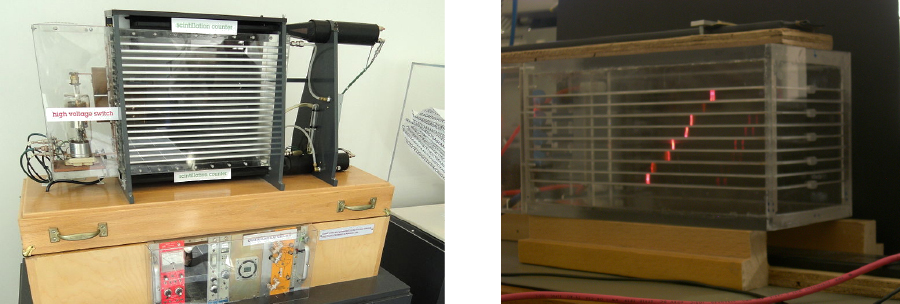
on dry days (Figure 7.3.5).Figure 7.3.5: A spark chamber is used to trace the paths of high-energy particles. Ionization created by the particles as they pass through the gas between the plates allows a spark to jump. The sparks are perpendicular to the plates, following
electric field
lines between them. The
potential difference
between adjacent plates is not high enough to cause sparks without the ionization produced by particles from accelerator experiments (or
cosmic rays
). This form of detector is now archaic and no longer in use except for demonstration purposes. (credit b: modification of work by Jack Collins)
Example 7.3.1B: Field and Force inside an
Electron
Gun
An
electron
gun (Figure 7.3.2) has parallel plates separated by 4.00 cm and gives electrons 25.0 keV of energy. (a) What is the
electric field
strength between the plates? (b) What force would this field exert on a piece of plastic with a 0.500−μC charge that gets between the plates?
Strategy
Since the
voltage
and plate separation are given, the
electric field
strength can be calculated directly from the expression E=VABd. Once we know the
electric field
strength, we can find the force on a charge by using F⃗ =qE⃗ . Since the
electric field
is in only one direction, we can write this equation in terms of the magnitudes, F=qE.
Solution
a. The expression for the magnitude of the
electric field
between two uniform metal plates is
E=VABd.(7.3.36)
Since the
electron
is a single charge and is given 25.0 keV of energy, the
potential difference
must be 25.0 kV. Entering this value for VAB and the plate separation of 0.0400 m, we obtain
E=25.0kV0.0400m=6.25×10⁵V/m.
b. The magnitude of the force on a charge in an
electric field
is obtained from the equation
F=qE.(7.3.38)
Substituting known values gives
F=(0.500×10⁻⁶C)(6.25×10⁵V/m)=0.313N.
Significance Note that the units are newtons, since 1V/m=1N/C. Because the
electric field
is uniform between the plates, the force on the charge is the same no matter where the charge is located between the plates.
Example 7.3.4C: Calculating Potential of a Point Charge
Given a point charge q=+2.0−nC at the origin, calculate the
potential difference
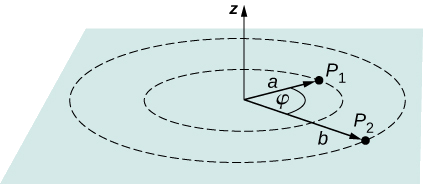
between point P1 a distance a=4.0cm from q, and P2 a distance b=12.0cm from q, where the two points have an angle of φ=24o between them (Figure 7.3.6).Figure 7.3.6: Find the difference in potential between P1 and P2.
Strategy Do this in two steps. The first step is to use VB−VA=−∫BAE⃗ ⋅dl⃗ and let A=a=4.0cm and B=b=12.0cm, with dl⃗ =dr⃗ =r^dr and E⃗ =kqr2r^. Then perform the integral. The second step is to integrate VB−VA=−∫BAE⃗ ⋅dl⃗ around an arc of constant radius r, which means we let dl⃗ =rφ⃗ dφ with limits 0≤φ≤24o, still using E⃗ =kqr2r^.
Then add the two results together.
Solution For the first part, VB−VA=−∫BAE⃗ ⋅dl⃗ for this system becomes Vb−Va=−∫bakqr2r^⋅r^dr which computes to
For the second step, VB−VA=−∫BAE⃗ ⋅dl⃗ becomes ΔV=−∫24o0okqr2r^⋅rφ^dφ, but r^⋅φ^=0 and therefore ΔV=0. Adding the two parts together, we get 300 V.
Significance
We have demonstrated the use of the integral form of the
potential difference
to obtain a numerical result. Notice that, in this particular system, we could have also used the formula for the potential due to a point charge at the two points and simply taken the difference.
Exercise 7.3.4
From the examples, how does the energy of a lightning strike vary with the height of the clouds from the ground? Consider the cloud-ground system to be two parallel plates.
Answer
Before presenting problems involving
electrostatics
, we suggest a problem-solving strategy to follow for this topic.


ليست هناك تعليقات:
إرسال تعليق