Gauss law states that the total electric flux out of a closed surface is equal to the charge enclosed divided by the permittivity. The electric flux in an area is defined as the electric field multiplied by the area of the surface projected in a plane and perpendicular to the field
? What Is Gauss Law
According to Gauss law, the total flux linked with a closed surface is 1/ε0 times the charge enclosed by the closed surface

For example, a point charge q is placed inside a cube of the edge ‘a’. Now, as per Gauss law, the flux through each face of the cube is q/6ε0.
The electric field is the basic concept of knowing about electricity. Generally, the electric field of the surface is calculated by applying Coulomb’s law, but to calculate the electric field distribution in a closed surface, we need to understand the concept of Gauss law. It explains the electric charge enclosed in a closed surface or the electric charge present in the enclosed closed surface.
Gauss Law Formula
As per the Gauss theorem, the total charge enclosed in a closed surface is proportional to the total flux enclosed by the surface. Therefore, if ϕ is total flux and ϵ0 is electric constant, the total electric charge Q enclosed by the surface is
Q = ϕ ϵ0
The Gauss law formula is expressed by
ϕ = Q/ϵ0
Where,
Q = Total charge within the given surface
ε0 = The electric constant
⇒ Also Read: Equipotential Surface
The Gauss Theorem
The net flux through a closed surface is directly proportional to the net charge in the volume enclosed by the closed surface.
Φ = → E.d → A = qnet/ε0
In simple words, the Gauss theorem relates the ‘flow’ of electric field lines (flux) to the charges within the enclosed surface. If no charges are enclosed by a surface, then the net electric flux remains zero.
This means that the number of electric field lines entering the surface equals the field lines leaving the surface.
The Gauss theorem statement also gives an important corollary:
The electric flux from any closed surface is only due to the sources (positive charges) and sinks (negative charges) of the electric fields enclosed by the surface. Any charges outside the surface do not contribute to the electric flux. Also, only electric charges can act as sources or sinks of electric fields. Changing magnetic fields, for example, cannot act as sources or sinks of electric fields.

Gauss Law in Magnetism
The net flux for the surface on the left is non-zero as it encloses a net charge. The net flux for the surface on the right is zero since it does not enclose any charge.
⇒ Note: The Gauss law is only a restatement of Coulomb’s law. If you apply the Gauss theorem to a point charge enclosed by a sphere, you will get back Coulomb’s law easily.
Applications of Gauss Law
1. In the case of a charged ring of radius R on its axis at a distance x from the centre of the ring.
2. In the case of an infinite line of charge, at a distance, ‘r’. E = (1/4 × πrε0) (2π/r) = λ/2πrε0. Where λ is the linear charge density.
3. The intensity of the electric field near a plane sheet of charge is E = σ/2ε0K, where σ = Surface charge density.
4. The intensity of the electric field near a plane-charged conductor E = σ/Kε0 in a medium of dielectric constant K. If the dielectric medium is air, then Eair = σ/ε0.
5. The field between two parallel plates of a condenser is E = σ/ε0, where σ is the surface charge density.
Electric Field Due to Infinite Wire – Gauss Law Application
Consider an infinitely long line of charge with the charge per unit length being λ. We can take advantage of the cylindrical symmetry of this situation. By symmetry, The electric fields all point radially away from the line of charge, and there is no component parallel to the line of charge.
We can use a cylinder (with an arbitrary radius (r) and length (l)) centred on the line of charge as our Gaussian surface.
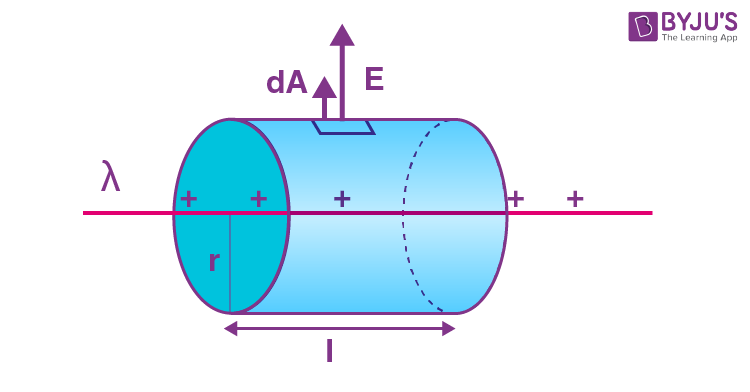
Applications of Gauss Law – Electric Field Due to Infinite Wire
As you can see in the above diagram, the electric field is perpendicular to the curved surface of the cylinder. Thus, the angle between the electric field and area vector is zero and cos θ = 1.
The top and bottom surfaces of the cylinder lie parallel to the electric field. Thus, the angle between the area vector and the electric field is 90 degrees, and cos θ = 0.
Thus, the electric flux is only due to the curved surface.
According to Gauss law,
Φ = → E.d → A
Φ = Φcurved + Φtop + Φbottom
Φ = → E . d → A = ∫E . dA cos 0 + ∫E . dA cos 90° + ∫E . dA cos 90°
Φ = ∫E . dA × 1
Due to radial symmetry, the curved surface is equidistant from the line of charge, and the electric field on the surface has a constant magnitude throughout.
Φ = ∫E . dA = E ∫dA = E . 2πrl
The net charge enclosed by the surface is
qnet = λ.l
Using Gauss theorem,
Φ = E × 2πrl = qnet/ε0 = λl/ε0
E × 2πrl = λl/ε0
E = λ/2πrε0
⇒ Also Read: Electric Potential Energy
Problems on Gauss Law
Problem 1: A uniform electric field of magnitude E = 100 N/C exists in the space in the X-direction. Using the Gauss theorem, calculate the flux of this field through a plane, square area of edge 10 cm placed in the Y-Z plane. Take the normal along the positive X-axis to be positive.
Solution:
The flux Φ = ∫ E.cosθ ds
As the normal to the area points along the electric field, θ = 0
Also, E is uniform so, Φ = E.ΔS = (100 N/C) (0.10m)2 = 1 N-m2
Problem 2: A large plane charge sheet having surface charge density σ = 2.0 × 10⁻⁶ C-m-2 lies in the X-Y plane. Find the flux of the electric field through a circular area of radius 1 cm lying completely in the region where x, y and z are all positive and with its normal, making an angle of 600 with the Z-axis.
Solution:
The electric field near the plane charge sheet is E = σ/2ε0 in the direction away from the sheet. At the given area, the field is along the Z-axis.
The area = πr2 = 3.14 × 1 cm2 = 3.14 × 10⁻⁴ m2.
The angle between the normal to the area and the field is 600.
Hence, according to Gauss theorem, the flux
= E.ΔS cos θ
= σ/2ε0 × pr2 cos 60º
= 17.5 N-m2C-1.
Problem 3: A charge of 4×10⁻⁸ C is distributed uniformly on the surface of a sphere of radius 1 cm. It is covered by a concentric, hollow conducting sphere of radius 5 cm.
- Find the electric field at a point 2 cm away from the centre.
- A charge of 6 × 10⁻⁸C is placed on the hollow sphere. Find the surface charge density on the outer surface of the hollow sphere.
Solution:
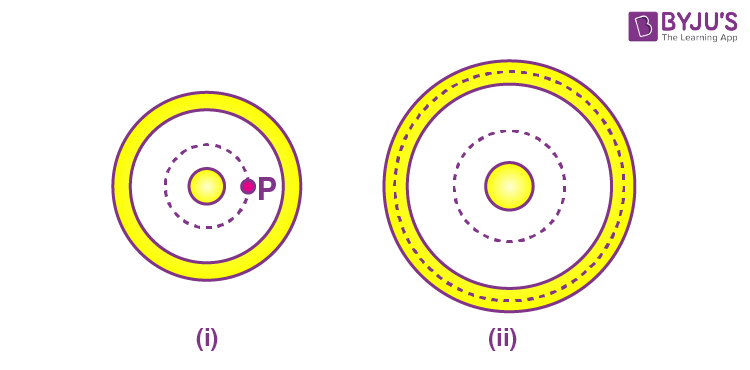
(a) Let us consider figure (i).
Suppose we have to find the field at point P. Draw a concentric spherical surface through P. All the points on this surface are equivalent; by symmetry, the field at all these points will be equal in magnitude and radial in direction.
The flux through this surface
= 4π x2 E
Where x = 2 cm = 2 × 10⁻² m
From the Gauss law, this flux is equal to the charge q contained inside the surface divided by ε0. Thus,
⇒ 4π x2 E = q/ε0 or, E = q/4πε0x2
= ( 9 × 10⁹) × [(4 × 10⁻⁸)/(4 × 10-4)] = 9 × 10⁵ N C-1.
(b) Let us consider figure (ii).
Take the Gaussian surface through the material of the hollow sphere. As the electric field in a conducting material is zero, the flux
through this Gaussian surface is zero.
Using Gauss law, the total charge enclosed must be zero. Hence, the charge on the inner surface of the hollow sphere is 4 × 10⁻⁸C.
But the total charge given to this hollow sphere is 6 × 10⁻⁸ C. Hence, the charge on the outer surface will be 10 × 10-8C.
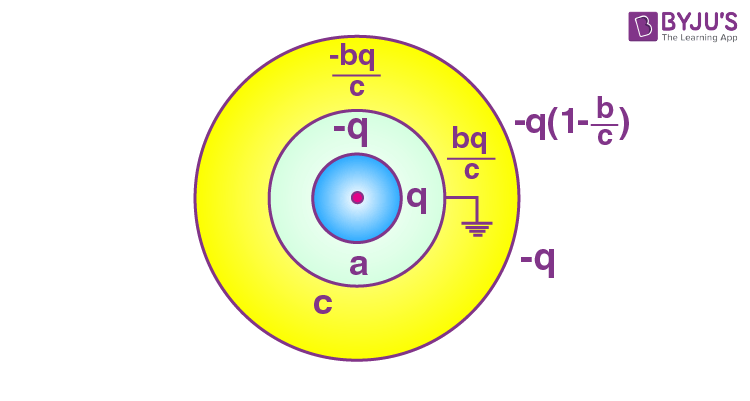
Problem 4: The figure shows three concentric thin spherical shells, A, B and C, of radii a, b and c, respectively. Shells A and C are given charges q and -q, respectively, and shell B is earthed. Find the charges appearing on the surfaces of B and C.
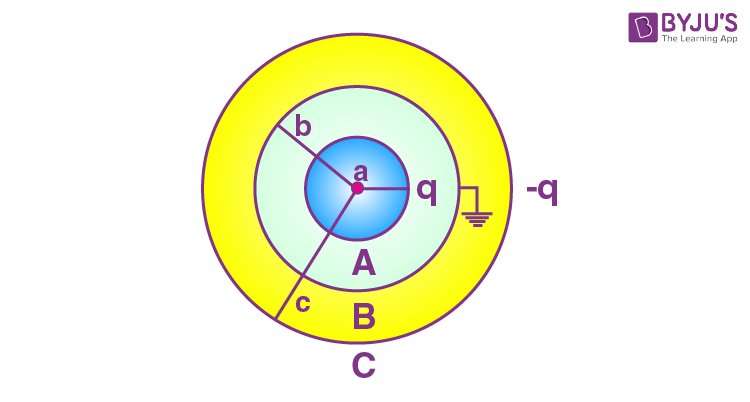
Solution:
As shown in the previous worked-out example, the inner surface of B must have a charge -q from the Gauss law. Suppose the outer surface of B has a charge q’.
The inner surface of C must have a charge -q’ from Gauss law. As the net charge on C must be -q, its outer surface should have a charge q’ – q. The charge distribution is shown in the figure.
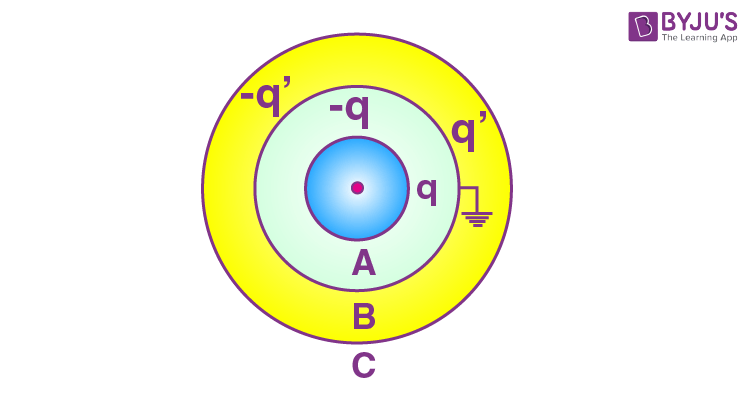
The potential at B,
- Due to the charge q on A = q/4πε0b
- Due to the charge -q on the inner surface of B = -q/4πε0b
- Due to the charge q’ on the outer surface of B = q’/4πε0b
- Due to the charge -q’, on the inner surface of C = -q’/4πε0c
- Due to the charge q’ – q on the outer surface of C = (q’ – q)/4πε0c
The net potential is, VB = q’/4πε0b – q/4πε0c
This should be zero as shell B is earthed. Thus, q’ = q × b/c
The charges on various surfaces are shown in the figure below.
Problem 5: A particle of mass 5 × 10⁻⁶g is kept over a large horizontal sheet of charge of density 4.0 × 10⁻⁶ C/m2 (figure). What charge should be given to this particle so that if released, it does not fall down? How many electrons are to be removed to give this charge? How much mass is decreased due to the removal of these electrons?

Solution:
The electric field in front of the sheet is
E = σ/2ε0 = (4.0 × 10⁻⁶)/(2 × 8.85 × 10-12) = 2.26 × 10⁵ N/C
If a charge q is given to the particle, the electric force qE acts in the upward direction. It will balance the weight of the particle, if
q × 2.26 × 10⁵ N/C = 5 × 10-9 kg × 9.8 m/s2
or, q = [4.9 × 10⁻⁸]/[2.26 × 105]C = 2.21 × 10⁻¹³ C
The charge on one electron is 1.6 × 10⁻¹⁹C. The number of electrons to be removed
= [2.21 × 10⁻¹³]/[1.6 × 10-19] = 1.4 × 10⁶
Mass decreased due to the removal of these electrons = 1.4 × 106 × 9.1 × 10-31 kg = 1.3 × 10⁻²⁴ kg.
Problem 6: Two conducting plates, A and B, are placed parallel to each other. A is given a charge Q1, and B a charge Q2. Find the distribution of charges on the four surfaces.
Solution:
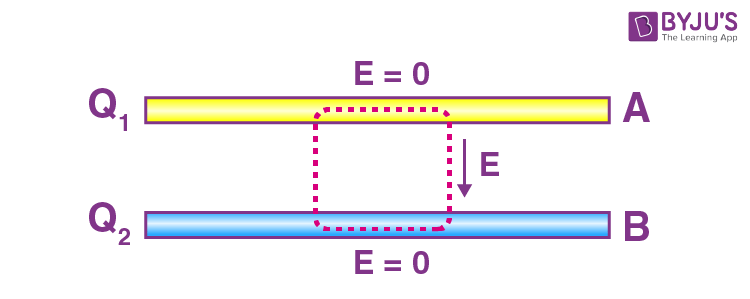
Consider a Gaussian surface, as shown in figure (a). Two faces of this closed surface lie completely inside the conductor where the electric field is zero.
The flux through these faces is, therefore, zero. The other parts of the closed surface, which are outside the conductor, are parallel to the electric field, and hence, the flux on these parts is also zero.
The total flux of the electric field through the closed surface is, therefore, zero. From the Gauss law, the total charge inside the closed surface should be zero. The charge on the inner surface of A should be equal and opposite to that on the inner surface of B.

The distribution should be like the one shown in figure (b). To find the value of q, consider the field at point P inside plate A. Suppose the surface area of the plate (one side) is A.
Using the equation E = σ/2ε0, the electric field at P
- Due to the charge Q1 – q = (Q1 – q)/2Aε0 (downward)
- Due to the charge +q = q/2Aε0 (upward)
- Due to the charge -q = q/2Aε0 (downward)
- Due to the charge Q2 + q = (Q2 + q)/2Aε0 (upward)
The net electric field at P due to all the four charged surfaces is (in the downward direction).
(Q1 – q)/2Aε0 – q/2Aε0 + q/2Aε0 – (Q2 + q)/2Aε0
As point P is inside the conductor, this field should be zero.
Hence, Q1 – q – Q2 – q = 0
or q = (Q1 – Q2)/2 . . . . . (i)
Thus, Q1 – q = (Q1 + Q2)/2 . . . . . . (ii)
and Q2 + q = [Q1 + Q]2/2
Using these equations, the distribution shown in figures (a, b) can be redrawn as in the figure.
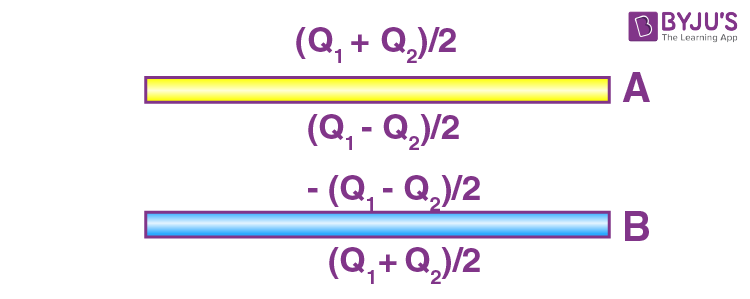
This result is a special case of the following result. When charged conducting plates are placed parallel to each other, the two outermost surfaces get equal charges, and the facing surfaces get equal and opposite charges.
Problem 7: A solid conducting sphere having a charge Q is surrounded by an uncharged concentric conducting hollow spherical shell. Let the potential difference between the surface of the solid sphere and that of the outer surface of the hollow shell be V. What will be the new potential difference between the same two surfaces, if the shell is given a charge -3Q?
Solution:
In the case of a charged conducting sphere,
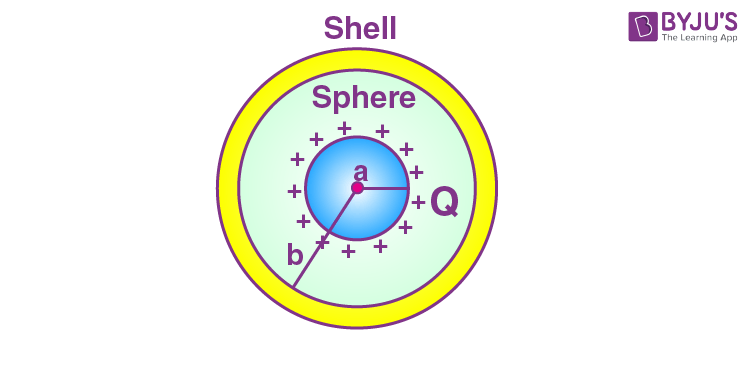
Vin = Vc = Vs = 1/4πε0
and Vout = 1/4πε0
So, if a and b are the radii of a sphere and spherical shell, respectively, the potential at their surfaces will be
Vsphere = 1/4πε0 [Q/a] and Vshell = 1/4πε0 [Q/b] and so according to the given problem,
V = V’sphere – V’shell = Q/4πε0 [1/a – 1/b] = V . . . . . . . (1)
Now, when the shell is given a charge (-3Q), the potential at its surface and also inside will change by
V0 = 1/4πε0 [ -3Q/b]
So now,
V’sphere = 1/4πε0 [Q/a + V0] and V’shell = 1/4πε0 [Q/b + V0]
Hence, V’sphere – V’shell = Q/4πε0 [1/a – 1/b] = V [from Eqn. (1)]
i.e., if any charge is given to the external shell, the potential difference between the sphere and shell will not change.
This is because by the presence of charge on the outer shell, potential everywhere inside and on the surface of the shell will change by the same amount, and hence, the potential difference between sphere and shell will remain unchanged.
Problem 8: A very small sphere of mass 80 g having a charge q is held at height 9 m vertically above the centre of a fixed nonconducting sphere of radius 1 m, carrying an equal charge q. When released, it falls until it is repelled, just before it comes in contact with the sphere. Calculate the charge q. [g = 9.8 m/s2]
Solution:
Keeping in mind that here, both electric and gravitational potential energy is changing, and for an external point, a charged sphere behaves as if the whole of its charge were concentrated at its centre.
Applying the law of conservation of energy between the initial and final position, we have
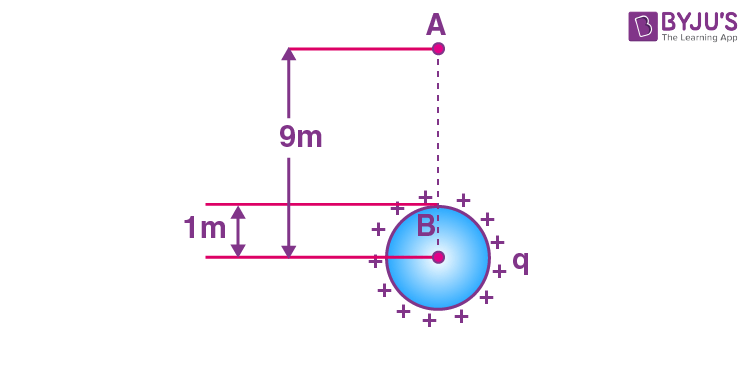
1/4πε0 × (q.q/9) + mg × 9 = (1/4πε0 ) x(q2/1) + mg × 1
or, q2 = (80 × 10-3 × 9.8)/109 = 28μC.


ليست هناك تعليقات:
إرسال تعليق