{Hallo every body today I will speak about {Calculus
.you know That I am doing my best to benefit you guys so lets go
Today I will speak about Chapter 1: Functions
The Definition*
Combination of Function*
Composition of Function*
Inverse Function*
What is a Function
A function relates an input to an output.

It is like a machine that has an input and an output.
And the output is related somehow to the input.
| f(x) | "f(x) = ... " is the classic way of writing a function. |
Input, Relationship, Output
We will see many ways to think about functions, but there are always three main parts:
- The input
- The relationship
- The output
Some Examples of Functions
- x2 (squaring) is a function
- x3+1 is also a function
- Sine, Cosine and Tangent are functions used in trigonometry
- and there are lots more!
Names
First, it is useful to give a function a name.
The most common name is "f", but we can have other names like "g" ... or even "marmalade" if we want.
But let's use "f":
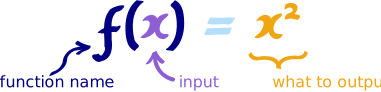
We say "f of x equals x squared"
what goes into the function is put inside parentheses () after the name of the function:
So f(x) shows us the function is called "f", and "x" goes in
And we usually see what a function does with the input:
f(x) = x2 shows us that function "f" takes "x" and squares it.
The "x" is Just a Place-Holder!
Don't get too concerned about "x", it is just there to show us where the input goes and what happens to it.
It could be anything!
So this function:
f(x) = 1 - x + x2
Is the same function as:
- f(q) = 1 - q + q2
- h(A) = 1 - A + A2
- w(θ) = 1 - θ + θ2
The variable (x, q, A, etc) is just there so we know where to put the values:
f(2) = 1 - 2 + 22 = 3
Sometimes There is No Function Name
Sometimes a function has no name, and we see something like:
y = x2
But there is still:
- an input (x)
- a relationship (squaring)
- and an output (y)
Relating
At the top we said that a function was like a machine. But a function doesn't really have belts or cogs or any moving parts - and it doesn't actually destroy what we put into it!
A function relates an input to an output.
Saying "f(4) = 16" is like saying 4 is somehow related to 16. Or 4 → 16



ليست هناك تعليقات:
إرسال تعليق