Hallo every body today I will speak about Electric Potential
This tutorial is all about the energy associated with electrical interactions. Every time you turn on a light or use an electronic device, you are using electrical energy, an indispensable component of our technological society. Using work and energy concepts makes it easier to solve a variety of problems in electricity. In circuits, a difference in potential from one point to another is often called voltage. Potential and voltage are crucial to understanding how electric circuits work and have equally important applications in many devices.
Electric Potential Energy
Electric field exerts force on a charged particle ( ) which can do work. This work can be expressed in terms of electric potential energy which is dependent on the position of the charged particle in the electric field; just as gravitational potential energy depends on the distance of a mass from the earth’s surface.
When a force  acts on a particle that moves from point a to
point b, the work done by the force is given by

Electric Potential Energy in a Uniform Field
For an electric field that exerts a force  ,
,

(3)
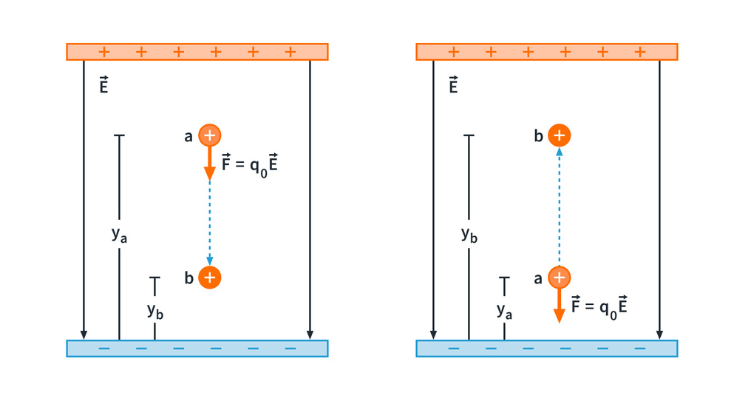
Consider a positive test charge  moving in a uniform electric field.
Figure 1: A positive charge moving (a) in the direction of  and (b) in the direction opposite
Figure 2: A negative charge moving (a) in the direction of  and (b) in the direction opposite
For Fig.2 (a), the work is negative since the force (pointing upward) is in the opposite direction as the net displacement of the negative test charge and the potential energy increases. For Fig.2 (b), the work is positive, and the potential energy decreases.
This shows us that whether the test charge is positive or negative, the following general rules apply:
 decreases if moves in the same direction as the electric force
- increases if moves in the opposite direction as the electric force
This is the same behavior as for gravitational potential energy, which increases if a mass m moves upward (opposite the direction of the gravitational force  ) and decreases if m moves downward (in the direction of ).
When increases: An alternative but equivalent viewpoint is to consider how much work we would have to do to “raise” a particle from a point b where the potential energy is  to a point a where it has a greater value
  (pushing two positive charges closer together, for example). To move the particle, we need to exert an additional external force
  that is equal and opposite to the electric-field force and does positive work. Therefore, the potential energy difference
  is the work that must be done by an external force to move the particle from b to a, overcoming the electric force. This viewpoint also works if is less than ; an example is moving two positive charges away from each other. In this case, is still equal to the work done by the force, but now the work is negative.
Electric Potential Energy of Point Charges
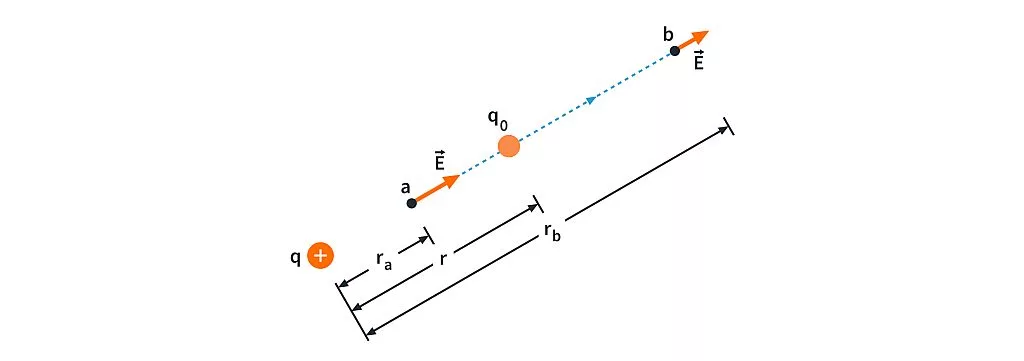
The idea of electric potential energy isn’t restricted to a uniform electric field. We can apply this concept to a point charge in any electric field caused by a static charge distribution. Recall that we can represent any charge distribution as a collection of point charges. It is therefore useful to calculate the work done on one test charge moving in the field caused by a stationary point charge  .
.
Figure 3: Test charge moves from a to b along a straight line extending radially from charge .
where  is the distance between the two charges. The potential energy is positive if the charges have the same sign and negative if they have opposite signs.
Potential energy is defined relative to a chosen reference point where  is assigned. In eq.(6), is zero when and are infinitely far apart (
 ). Therefore represents the work that would be done on the test charge by the field of if moved from an initial distance r to infinity. If and have the same sign, the interaction is repulsive in that they will repel each other, the work is positive, and is positive at any finite separation. As r approaches infinity, decreases and approaches zero. If and have opposite signs, the interaction is attractive, the work done is negative, and is negative. As r approaches infinity, increases and approaches zero.
We emphasize that the potential energy given by eq.(6) is a shared property of the two charges. If the distance between and is changed from  to
to  , the change in potential energy is the same whether is held fixed and is moved or is held fixed and is moved. For this reason, we never use the phrase “the electric potential energy of a point charge.” Likewise, if a mass m is at a height h above the earth’s surface, the gravitational potential energy is a shared property of the mass m and the earth.
Suppose the electric field in which the charge moves is caused by several point charges  ,
,  ,
,  , ... at distances
  ,
,  ,
,  from .




 is an infinitesimal displacement along the particle’s path and
  is the angle between
  and
and  and the work done by the force is
 , if the work is positive then the potential energy (
  ) decreases. For Fig.1 (b), the field does negative work on the charge and the potential energy increases.
 moving in a uniform electric field. Recall that when
  is negative, the force is opposite the field direction.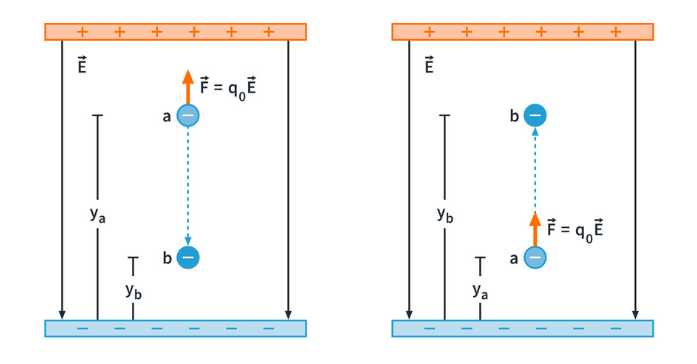


 if we define the potential energy at a and b to be
 when
when  when
when 


